Parents of disabled and special needs children are asked to be caregiver, advocate, scheduler, and employee—often all before lunch. If you’re trying to keep a career moving without losing yourself, the answer isn’t “try harder.” It’s building a rhythm that survives interruptions.

In a nutshell
Pick a few non-negotiables, shrink goals into bite-size steps, and add buffers on purpose. Ask for help earlier than you think you “deserve,” and treat rest as maintenance. Progress looks like steadier momentum, not perfect balance.
Bandwidth-first planning
A common trap is setting professional goals that assume predictable days. Instead, plan for variability:
- Modular work: tasks you can finish in 20–45 minutes.
- Restart notes: end each session with “next step + file link + question.”
- Two-speed targets: a “minimum” version for hard weeks and a “stretch” version for good weeks.
If you have job choice, prioritize roles with fewer surprise nights/weekends, clearer handoffs, and kinder deadlines. - Declare two protected windows each week (even 30 minutes). Put them on the calendar.
- Use a “one-sentence no.” “I can’t take that on this week, but I can revisit next Monday.”
- Limit context switching. Keep meds, contacts, routines, and school notes in one place.
- Protect one identity pocket. A walk, a class, art, faith practice, a game night—something that isn’t caregiving or productivity.
- Scan the next 7 days (appointments + school + deadlines). Mark the two hardest days.
- Pick one work outcome you can point to (send proposal, finish report, apply to two roles).
- Schedule two buffers (a flexible hour or a lighter evening).
- Pre-decide your rescue plan for a rough day: the meal, the email template, the “cancel kindly” text.
- Assign ownership (who calls the pharmacy, who answers school messages, who handles forms).
- Write tomorrow’s first 5-minute step so you don’t have to “rev up” to begin.
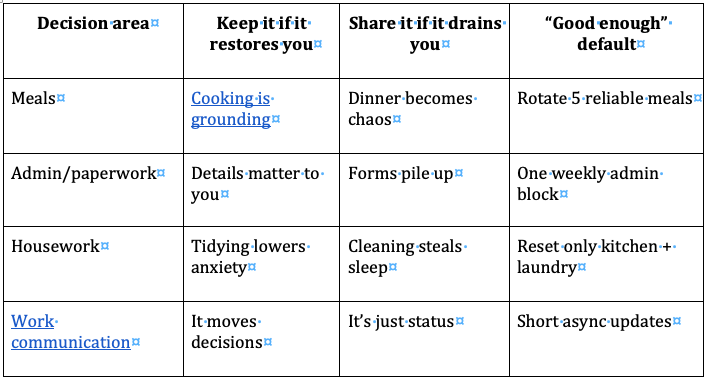
A small table that saves big arguments
Use this as a neutral way to decide what gets your time. Nothing here is a moral scorecard.
Career growth that respects your reality
Sometimes the most practical lever is widening your options: roles with better pay, more flexibility, or remote work. Earning a degree can improve your career prospects by strengthening your credentials and opening doors to new job tracks. Online degree programs can make it easier to earn your degree while still working full-time or tending to family obligations. One option is the data analytics graduate program. Earning an online master’s degree in data analytics could allow you to develop your skills in data science, theory, and application.\
Micro-boundaries that don’t require a perfect day
The 20-minute weekly reset checklist
Do this once a week to reduce “surprise stress”:
A practical resource when you need relief, not another tip
Respite care can be a career-protector and a sanity-protector. The ARCH National Respite Network & Resource Center’s National Respite Locator – a service USA-wide, helps caregivers search for respite options and offers guidance on choosing providers. Other countries may also offer respite for caregivers. If you’re feeling stuck, start small: even one planned hour of respite a week can lower the constant “on-alert” stress and make the rest of your schedule more workable. And remember—using respite support isn’t a luxury or a failure; it’s a practical way to protect your health, your relationships, and your ability to keep showing up at home and at work.
FAQ
How do I ask for flexibility at work without oversharing?
Lead with logistics and outcomes: what you need, how you’ll deliver, and when you’ll update.
What if my partner and I keep “trading exhaustion”?
Divide by ownership, not minutes. One person owns school communication; the other owns medical scheduling. Revisit monthly.
I feel guilty taking time for myself—what do I do with that?
Name it as a signal, not a verdict. Rest protects your patience, your health, and your ability to stay employed.
Conclusion
Balance isn’t a finish line; it’s a set of small choices you repeat. Build for the week you actually have, not the one you wish you had. When you add buffers, boundaries, and real support, your career goals become less fragile. And your personal life starts to reappear in the margins—then in the center.